The city of
Brainerd has been flushing money down the drain- or so say those advocating an overlooked resource to heat and cool the city's buildings through Minnesota's bitter winters and
increasingly hot summers. That resource is
the sewers.
Scott Sjolund is technology supervisor Brainerd Public Utilities, which has
already been using heat from waste water to heat its buildings and clear sidewalks of ice. He explains: "Everybody heats water up ... and all that gets drained down the sewer,
and that's potential energy that could be extracted. That's part of the
equation." The other part is harnessing it most effectively.
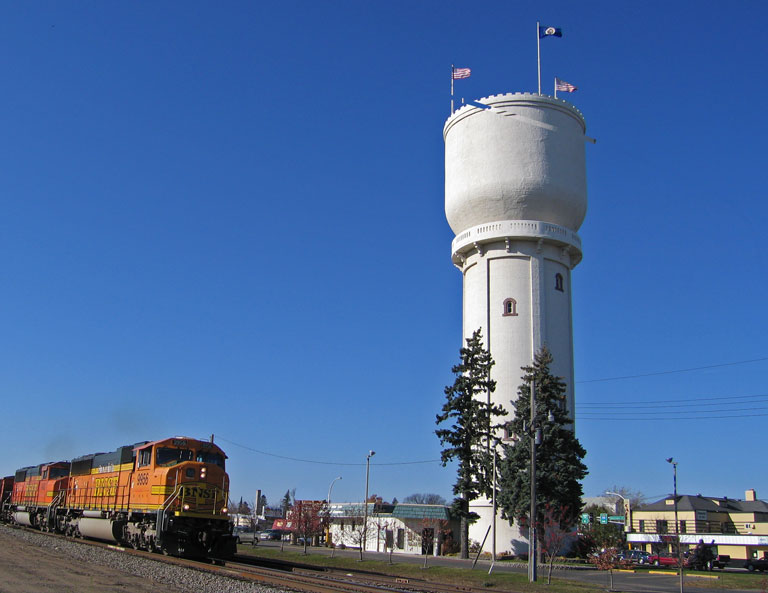
Brainerd's signature water tower, known as 'Paul Bunyan's Cup'
Hidden Fuels, a company based in the city, has an idea. The company, which received a $45,000 grant from the federal government and formed a partnership with the city and school district in 2009, has already used a series of sensors to map out the flow of heat in the sewers and find the hot spots. Peter Nelson of Hidden Fuels says, "It shows that there's a significant amount of energy — literally enough
to heat hundreds of homes — within the streets of the city of
Brainerd". There's enough heart in one pipe to heat the entire high school, according to Earl Wollert, the Brainerd School district director of buildings and grounds.
Hidden Fuels intends to use the energy by running water through a heat pump,
running a turbine that generates the electricity that will heat or cool the building. It is similar to the use of
geothermal energy, but with a bonus- the Brainerd sewer water, at 42-66 degrees Fahrenheit, is already generally in the temperature range. According to John Lund of the Oregon Institute of Technology, using the sewer water could cut costs in half compared to regular geothermal.
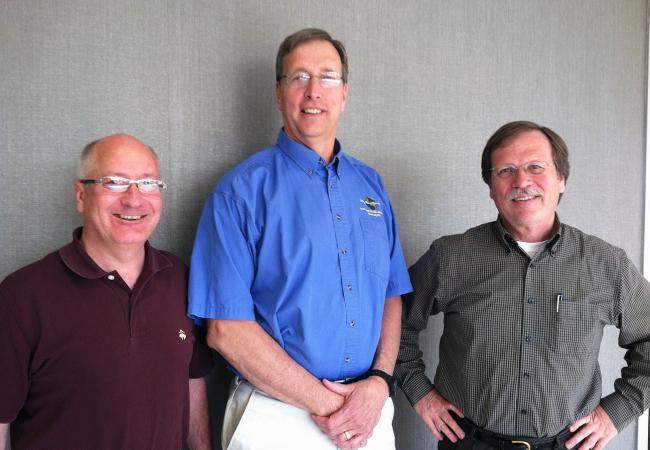
Jeffry Aga, Alan Cibuzar, and Peter Nelson of Hidden Fuels
There remain some drawbacks, however. One is the use of dirty water. Prior to now, geothermal systems have generally used clean water. In the words of Nelson, "We're dealing with contaminated fluids. And so that's really the
challenge ... to be able to operate efficiently in that contaminated
environment." The company intends to extract the energy in a closed system with a clean glycol process, reducing odor concerns.
Another possible problem is that with natural gas prices as low as they are, even the reduced-cost sewer power may be more costly than natural gas. Even though heating the school alone could
save around $18,000 annually, it could still take years to break even compared to the cost of natural gas- though such calculations neglect the significant environmental costs of natural gas and the
controversial fracking method by which it is gathered.
Regardless, with the price of fossil fuels in the future uncertain, the project is slated to be a long-term investment. Hidden Fuels plans to have the police station heated by the end of the year, with the school also on the agenda. In the Brainerd of tomorrow, the streets may not be paved with gold, but gold may certainly flow under them.
Image Sources:
The Gilbert Lodge Blog,
MPR
 The Energy Solutions Home, part of the Eco Experience exhibit, is a partnership of public agencies, contractors, retailers, utilities, advocacy groups, and other parties, presented by the Minnesota Department of Commerce. will show a range of energy-saving technologies. There will be a Green Materials and Efficient Appliances Display, a Heating, Ventilation, and Air Condition Display, and a Sustainability Stage for demonstrations. Miniature gardens displaying rain barrels and drip irrigation take the efficiency not only to electricity, but to water as well.